
The Global Longing for Transformation
Across the world’s major spiritual and religious traditions, there is a recurring expectation that humanity will undergo a profound transformation. While the details differ, the underlying intuition is remarkably consistent: the world is not as it should be, and a turning point is coming.
AD
4/1/20262 min read
A Unified Vision: The Global Longing for Transformation
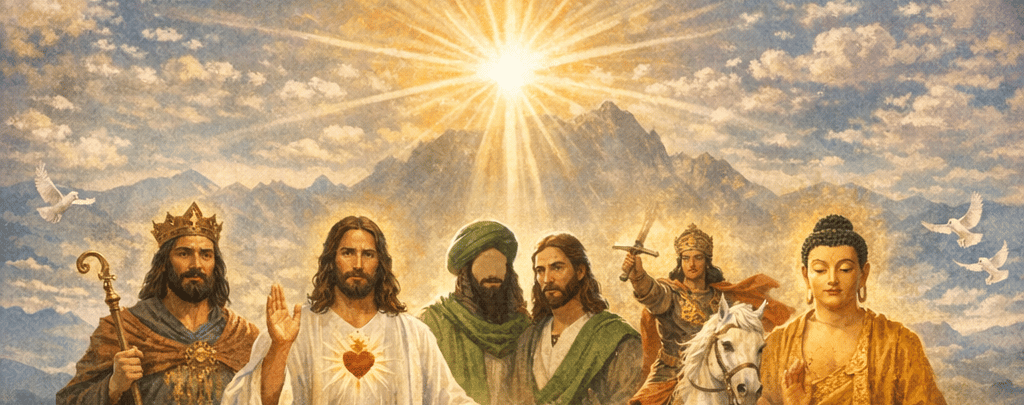
Across the world’s major spiritual and religious traditions, there is a recurring expectation that humanity will undergo a profound transformation. While details differ, a remarkably consistent intuition persists: the world is currently out of balance, and a significant turning point is coming. This document synthesizes these diverse perspectives to highlight their common ground and the universal human longing for restoration.
The Temporal Framework: Linear vs. Cyclical
A primary distinction in these traditions lies in how they perceive time.
Linear History (Abrahamic Traditions): Judaism, Christianity, and Islam generally view history as moving forward toward a final, definitive event.
Cyclical History (Eastern Traditions): Hinduism views time as repeating cycles called yugas. We are currently in the Kali Yuga, an age of decline and moral decay.
Perspectives on Transformation by Tradition
Judaism: Restoration of Moral Order
Judaism anticipates a future era defined by justice, peace, and a restored moral order.
Nature of Change: The world is healed and set right visibly and politically.
The Catalyst: A human king from David’s line.
Key Features: This transformation involves the end of war , universal justice , the return of exiles , and the restoration of the Temple. It emphasizes ethical renewal rather than cosmic drama or divine incarnation.
Christianity: A Cosmic Recreation
Christianity expects a universal and final cosmic transformation.
Nature of Change: The world is not merely repaired; it is entirely recreated, marking the end of the old order.
The Catalyst: Jesus the Christ, who is both divine and human.
Key Features: Transformation includes the defeat of evil , the abolition of death , the resurrection of the dead, and God dwelling directly with humanity.
Islam: Purified Justice
Islam expects a global correction of injustice followed by a period of peace.
Nature of Change: This is a purified and corrected version of the existing world. It is dramatic but not "cosmic" in the sense of a new creation.
The Catalyst: Two figures, the Mahdi (a righteous leader) and Jesus the Messiah (a returning prophet).
Key Features: Falsehood and the Antichrist are destroyed , justice is established, and true monotheism is restored. It stresses truthfulness and moral clarity over divine incarnation.
Hinduism: Realignment with Dharma
Hinduism expects a turning point at the end of the current age of darkness.
Nature of Change: The destruction of corruption to begin a new golden age, the Satya Yuga.
The Catalyst: Kalki, the tenth and final avatar (divine manifestation) of Vishnu.
Key Features: The focus is on cosmic balance and the necessity of realigning with dharma (universal order).
Buddhism: Educational Awakening
Buddhism anticipates the arrival of Maitreya, a future Buddha.
Nature of Change: A transformation focused on the rediscovery of wisdom and clarity.
The Catalyst: Maitreya, who reintroduces the Dharma (teachings) after it has been lost.
Key Features: Transformation is primarily educational and collective, with awakening spreading through many individuals.
Comparison of Traditions
The following table compares how each tradition envisions the catalyst and the resulting state of the world:
The Shift to Collective Awakening
While traditions often focus on a single messianic figure, deeper teachings suggest that real change does not emerge from one individual alone. Instead, transformation arises through the collective awakening of many responsible and clear-seeing individuals.
Judaism: Relies on many prophets and righteous individuals.
Christianity: Sees the Spirit poured out on all people.
Islam: Views the community as being guided collectively.
Hinduism: Notes that many realized souls appear even in dark ages.
Buddhism: Maintains that awakening is a potential available to all.
Ultimately, these traditions converge on a shared vision: a future rooted in justice, wisdom, and renewed understanding. By recognizing this shared expectation, people of diverse backgrounds can find common ground to work toward a more compassionate and awakened world.
© SDBEST LLC, 2025. All rights reserved.
alan@wambology.org